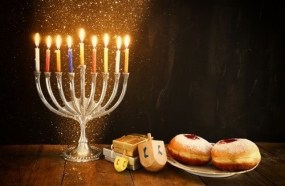
 The following resources are provided as a guide for celebrating the eight days of Chanukah in your home.
Latest
Chanukkah Home Celebration Kit
Hanukkah….A Time for Re-dedication
 Most people identify Hanukkah celebrations with being Jewish. And with eight days of lighting an extra-long menorah (chanukkiah), eating extra oily potatoes (latkes), playing a game using Hebrew letters (Dreidel), it’s no wonder.
But don’t let its Jewish symbols fool you. Hanukkah is the perfect celebration for anyone who’s ever wished for good to overcome evil, a minority of principled people to triumph over a powerful, oppressive empire, a restoration of crushed cultural traditions, a chance to clear out the bad memories and start anew, and recommit to living by their values and beliefs. Read the rest of this page »
How Can I Observe the Sabbath Without a Congregation?
 I hear this question a lot. In fact, I used to ask this question a lot. You may feel the pull of the Holy Spirit to observe the Sabbath. You may find that your heart and perspective toward the scriptures, the Israelites of old and the land of Israel today is different than those you currently worship with at church on Sunday.
But now what? You don’t know anyone else who is pursuing these things; there’s no gathering on the Sabbath that you can be part of. How can you keep the Sabbath on your own? What should you be doing? What about the command of assembling with others on the Sabbath? Read the rest of this page »
Feast of Trumpets: “A day of complete rest for remembering”
 On the Feast of Trumpets (also called Rosh Hashanah) we put aside our work and gather with other believers, share a meal, blow our shofars, present an offering and worship just as Yehovah commanded us in Leviticus 23.
But Leviticus 23:24 also tells us this is to be “a day of complete rest for remembering.” Remembering what, it doesn’t say. In fact none of the references to the Feast of Trumpets tell us what we’re remembering.
To get some perspective, let’s go back in time about 3,500 years when the observance of this day was first commanded. Read the rest of this page »
Our Calling This Shemitah Year, Part 1: The 5 Primary Events of Wrath
 In 2014, the Feast of Trumpets kicked off the Shemitah year. Nine days later was the Day of Atonement (Yom Kippur), and just three days after that the second of four blood moons occurred. The Feast of Trumpets, The Day of Atonement, the Shemitah year, the tetrad of blood moons – what do all these have to do with each other? What do they have to do with us? And what can we do to participate in God’s plan? Read the rest of this page »
Our Calling This Shemitah Year, Part 2: Blood Moons, the Feasts and Our Role
In Part 1, we looked at the progressive revelation of God’s wrath, including the five primary acts of God’s wrath, the five elements common to each, and the three milestones marking where we are in the timeline. With that in mind, I want to overlay one more aspect that brings us to our current day.
The Shemitah & Blood Moons
Preparing for Yom Kippur: 40 Days of Repentance, Part 1
 How would you characterize the month of August? How about September? Or January? Just like the Gregorian calendar in which each month reminds us of the season and a mood, the Hebrew sages have determined the spiritual seasons of the year.
The Hebrew month of Elul is considered the start of the “Season of Repentance.” This season extends 40 days, from Elul 1 to Tishrei 10, the Day of Atonement (Yom Kippur). Read the rest of this page »
Preparing for Yom Kippur: 40 Days of Repentance, Part 2
In Part 1, we looked at the Hebrew understanding of the month of Elul, which begins 40 days before Yom Kippur (The Day of Atonement). From the days of the Israelites in the wilderness, this period has emerged as a Season of Repentance, specifically repentance from idolatry, and originally the idolatrous Golden Calf.
For us it may not be a statue, figurine or carved image, but idolatry can take many forms. Repentance is an ongoing process of discovery of sin in our lives and realignment with God’s ways. In my own journey I’ve found four places where idolatry can hide and have watched God realign my life as I walk through each one. We’ve discussed the first two: discontentment and following my own plans. Let’s continue with the third:
The Day of Atonement: Yeshua Already Paid for That
 “…and forgive us our debts as we forgive those who trespass against us.” (Matt. 6:12)
…”Forgive, and you will be forgiven.” (Luke 6:37)
Forgiveness: Relinquishing our desire to punish another for their offenses. (Dr. Jerry Cook)
Easy to understand, hard to apply. But The Day of Atonement (Yom Kippur in Hebrew) is all about forgiveness – God’s forgiveness of man, and man’s forgiveness of others. Yom Kippur (literally translated the Day of Atonements) is the sixth in the seven Biblical Feasts. It commemorates God’s annual forgiveness of the Israelites as a nation and God’s forgiveness of all through Yeshua’s death. Likewise, it’s a time when we are to forgive others. Read the rest of this page »
What Are You Making God?
 I lifted my most pressing heart’s desire to God, as I make a habit of doing on the Sabbath. Later that day, He began answering me, as He often does on the Sabbath.
A new opportunity arose from someone in my congregation, and I was asked to participate. Wow, I’d never thought of that idea, I didn’t even know we had those resources. It was an obvious God-incidence in answer to my prayer. I was excited about the prospect and what it could lead to.
What Did Jesus Say About the Sabbath?
 Often we hear that Jesus taught against the Sabbath as a day of rest. After all, he healed on the Sabbath, he defended his disciples for picking grain on the Sabbath. Every time the Pharisees challenged him about the rules of the Sabbath, he set them straight that “The Sabbath is made for man, not man for the Sabbath.” (Mark 2:27)
I heard those teachings; I read the Pharisees’ criticism of his actions on the Sabbath and Jesus’ responses defending himself and his disciples. I was convinced that the Sabbath and all its rules had been done away with when Jesus came and taught us the New Covenant.
Then I read the original instructions for the Sabbath in the “Old Testament.” Read the rest of this page »
Purim – Partnering with God to Bring His Will
“As a Christian, serious about living out Christ’s intention for me, I view life as a series of opportunities to respond to and maximize… to recognize opportunities – either immediate or in the future – and prepare for, or respond well to them.” Dr. Jerry Cook
This summarizes our partnership with God in bringing his will. This is exactly what Esther and Mordecai did when the Jews were threatened with extermination by the Persians, as recorded in the Book of Esther – the story commemorated on the festival of Purim. Read the rest of this page »
Purim – The Story of Mordecai
 Esther – Queen of Persia, intercessor for the Jews before the King, and the one for whom the book of Esther is written. Understandably, as the heroine of the story, most discussions of the book are meant to inspire people to emulate her. But how many people are going to get the chance to be a queen, and in a position to intercede for their people in front of a king? Re-reading the story this year, I realized Mordecai’s role in the whole affair is probably a more realistic picture of what people in any position could aspire to. Read the rest of this page »
Hanukkah? Chanukah? And Why Does the Date Keep Changing?
 Hanukkah — or Chanukah as it’s sometimes spelled, typically falls sometime in December. I had heard of it, but didn’t actually know what it celebrated. So one day I decided to look into it. If you’re at that point, I can save you some time.
It turns out, it’s really not the Jewish version of Christmas. It’s not even the most important Jewish holiday. It just happens to usually fall between America’s biggest holidays — Thanksgiving and Christmas — so we end up throwing it in with the majors. Not to say that what’s celebrated is not a big deal. Here’s what I found out… Read the rest of this page »
As Hanukkah’s Candles, We Light up the Darkness
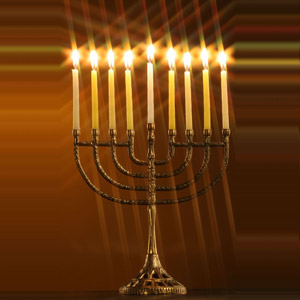 “Arise, shine, for your light has come, and the glory of the Lord rises upon you.” Isaiah 60:1
I find no evidence that this passage was originally about Hanukkah. It’s meant as a prophecy about Israel in the Millennial Age. But as I was contemplating the Hanukkah candles, this verse came to mind.
Then as I read verses 2-3, I realized how much this really parallels the idea of the Hanukkah candles:
“See, darkness covers the earth and thick darkness is over the peoples, but the Lord rises upon you and his glory appears over you. Nations will come to your light, and kings to the brightness of your dawn.” Isaiah 60:2-3
I decided to take a closer look at this passage and some of the Hanukkah themes that it contains. Read the rest of this page »


 Messianic Sabbath