A daily break to celebrate our salvation in Yeshua (Jesus) and our abundant life through the Torah

Latest

Why celebrate all these Jewish holidays? Haven’t those been done away with?

There are seven Feasts or Holy Days commanded in the Bible – four in the Spring, and three in the Fall.  It’s true, Jews had been observing these Feasts for 1,400 years before Yeshua’s birth.  But what if Yehovah set those dates as days He intends to fulfill specific prophecies in Yeshua’s lifetime and His second coming?  Wouldn’t you want to know which dates those were?  Let’s recount what happened on the Spring Feast dates during Yeshua’s lifetime. Read the rest of this page »

Thank Goodness for The Feast of Tabernacles!

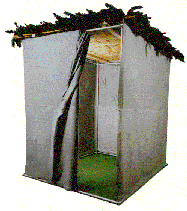
SukkahA pandemic, economic uncertainty, fear, division – the headlines bombard us.  The low level hum of a looming turmoil grows louder.  Thank goodness for The Feast of Tabernacles!

The Feast of Tabernacles, called Sukkot in Hebrew, is the seventh and last Feast in God’s holy days.  It looks back to God’s unlimited provision for the Israelites as they sojourned 40 years in the wilderness.  During the seven days of Sukkot, we spend time in our flimsy, homemade shelters to remind us of our complete dependence on God.  Sukkot also looks forward to the Millennial Age where we will “tabernacle” with Yeshua eternally.

But there’s an often overlooked aspect to this Feast.  Read the rest of this page »

The Feasts of the Lord: Going Through the Motions

Spring FeastsPassover, Feast of Unleavened Bread, Feast of First Fruits, Pentecost, Feast of Trumpets, Day of Atonement, Feast of Tabernacles – lots of Feasts, each with different instructions for observing them. Sometimes when we’re just starting out observing the Feasts, or approach a new season of Feasts, we can easily think of all the instructions and do’s and don’ts, and forget the richness of each Feast.  It can feel – and in fact become – like we’re just going through the motions.

I can imagine that’s how the Hebrews must have felt when they heard the instructions for the first time as well.  Exodus 12 is 50 verses full of instructions for Passover and the Feast of Unleavened Bread.  And the instructions are not exactly intuitive or logical.  What were they to make of killing a lamb and smearing its blood on their door frames?  Had that ever saved them from death before?  Was this a common practice?  And what’s so bad about leavened bread?  What does that have to do with saving their firstborns? Read the rest of this page »

Preparing to Enter Our Promised Land – Part 2

Image271In Numbers 1-2 God appoints leaders from each tribe of the Israelites, counts the men for military battle and organizes them as to how they are to camp and move.  By Numbers 10 they are moving toward the Promised Land.  These are our bookends in this study.  Everything within this 20-day period can be considered the last minute instructions before the Israelites can move forward.

In Part 1, we referenced Hebrews 3-4, in which Paul points out,

“it still remains for some to enter that rest, and since those who formerly had the good news proclaimed to them did not go in because of their disobedience, God again set a certain day, calling it ‘Today.’ ”  … “There remains, then, a Sabbath-rest for the people of God;”

The last minute preparations in how to enter our Sabbath rest in these last days are the same for us as they were for the Israelites in Numbers 1-10.  These are our instructions for what is required in order for God to fulfill His promises to us. Read the rest of this page »

Preparing to Enter Our Promised Land – Part 1

Image271

Numbers 1 begins the culmination of God’s main purpose for the Exodus:  entering the Promised Land.  Hebrews 4 tells us we are still headed for the Promised Land, calling it our Sabbath rest.  Numbers 1-14 are the last few weeks before His grand plan is finally realized.  The first 10 chapters provide an outline of how to prepare to enter the Land – for the Israelites, and for us today.  These are the last few instructions for following God’s presence into our land of blessing and abundance. Read the rest of this page »

The Spring Feasts: A Time to Remember, A Time to Anticipate

matzah verseTypically we think of the Spring Feasts as a time to remember – the Exodus and Yeshua’s death on Passover, his resurrection on the Feast of Firstfruits, the giving of the Torah and the Holy Spirit on Pentecost.

Then, we think of the Fall Feasts as a time to anticipate – Yeshua’s return on the Feast of Trumpets, the Lamb’s Book of Life opening on the Day of Atonement and tabernacling with Yeshua on the Feast of Tabernacles.

However, I found there’s also more to anticipate in the Spring Feasts.  There’s more to come.  The remembering helps us understand what to anticipate in the future. Read the rest of this page »

Why Count the Omer? Part 2: Nine Days of Prayer

counting the omer 2In Leviticus 23:15 God instructs us to count the seven weeks (49 days) that occur before the Day of Pentecost (the 50th day) also called the Festival of Weeks and Shavuot in Hebrew.  But counting days with no explanation? Why would this be important to God and to us?

For the Israelites, it pertained mainly to their harvest cycle and offerings to be presented.  For us living after the time of Yeshua, and the giving of the Holy Spirit to the disciples, we can see the spiritual implications of this count.  We know that on the 50th day after Yeshua’s resurrection, something unimaginably wonderful happened:  The pouring out of the Holy Spirit not only on the disciples, but on all those who come to faith in Yeshua as the Messiah!  The implications of that day reverberate even stronger in these last of the last days.  The 50th day is one I want to be prepared for every year. Read the rest of this page »

Why Count the Omer? Part 3: God’s Spirit Poured Out

counting the omer 2This 3-part blog series focuses on the Lord’s instruction in Leviticus 23:15 to count the seven weeks (49 days) that occur before the Day of Pentecost (the 50th day) also called the Festival of Weeks and Shavuot in Hebrew.  For the Israelites, the count was about the harvest, thus the word “omer” which was a unit of measure used to count and track grain harvests.  Yeshua taught us the spiritual meaning of “harvest” as those ready to receive the good news of the Messiah (Matt 9:37).  That’s what the third phase of counting the omer is about.

In Parts 1 and 2, I laid out a three-phase structure for the 49-day count:

  1. The first 40 days
  2. Days 41-49
  3. The 50th day

The first two phases prepare us for what’s about to happen on the 50th day and beyond. Read the rest of this page »

God’s Blessing & Provision: All Who Call on the Name of the Lord Will be Saved

www.DanKarvasek.comIn the posts leading up to this, I discussed the balance between stewarding our resources for the difficult times ahead, while maintaining complete dependency on Yehovah’s provision during those times.  In Part 2, we looked at Joseph as a type of Messiah who foreshadows how Yehovah will provide for us during times of tribulation.  But all of this assumes one very important requirement on our part: Calling on the name of the Lord.

This is certainly not a new concept.  It might seem obvious to most.  But I hadn’t seen the full meaning of this principle until I put it into the perspective of tribulation.  What had been a wonderful spiritual understanding now took on literal significance. Read the rest of this page »

The Blessing of the 10 Commandments: A Case in Point

Image271In an earlier post, we reviewed the lifestyle of following the 10 Commandments and the blessings it produces based on Deuteronomy 26:16-19.  But God’s blessings go beyond human logic.  It’s not only that if you do this, then that will happen. While that is certainly true in the natural realm, when we pursue God’s commands, the spiritual results are compounded beyond what we can imagine. Read the rest of this page »

The 10 Commandments: A List or a Lifestyle? (5-10)

Walk in the WoodsAt the end of Deuteronomy there’s a blessing for those who keep the commandments described throughout the book.  The summary of them is in Deuteronomy 5, known as the 10 Commandments.   But these commands are more than what we typically think of when we hear that reference–more than a list of do’s and don’ts, more than a checklist of how we’ve done in being a good person.  These commandments describe a lifestyle in alignment with God’s character and heart and His will for us.  In this 2-part blog, we’re looking at the lifestyle behind each command to see just how this blessing comes about as we align with Him.  Read the rest of this page »

Resting in God’s Faithfulness: Faith for Fear

DSC_0313In an earlier post, I shared how God had helped me identify six idols in my life – those things I put my trust in either in addition to Him or instead of Him.  After a 40-day examination of my attitudes toward them, I realized they were borne out of fear—fear of losing those things I depended on for security.  During that time God provided me a new perspective more closely aligned with His desire for my abundant life and which helped me to stay in his place of peace and rest.

A year later, I still kept God’s word to me on my desk: Read the rest of this page »